Phase 2: Bridge
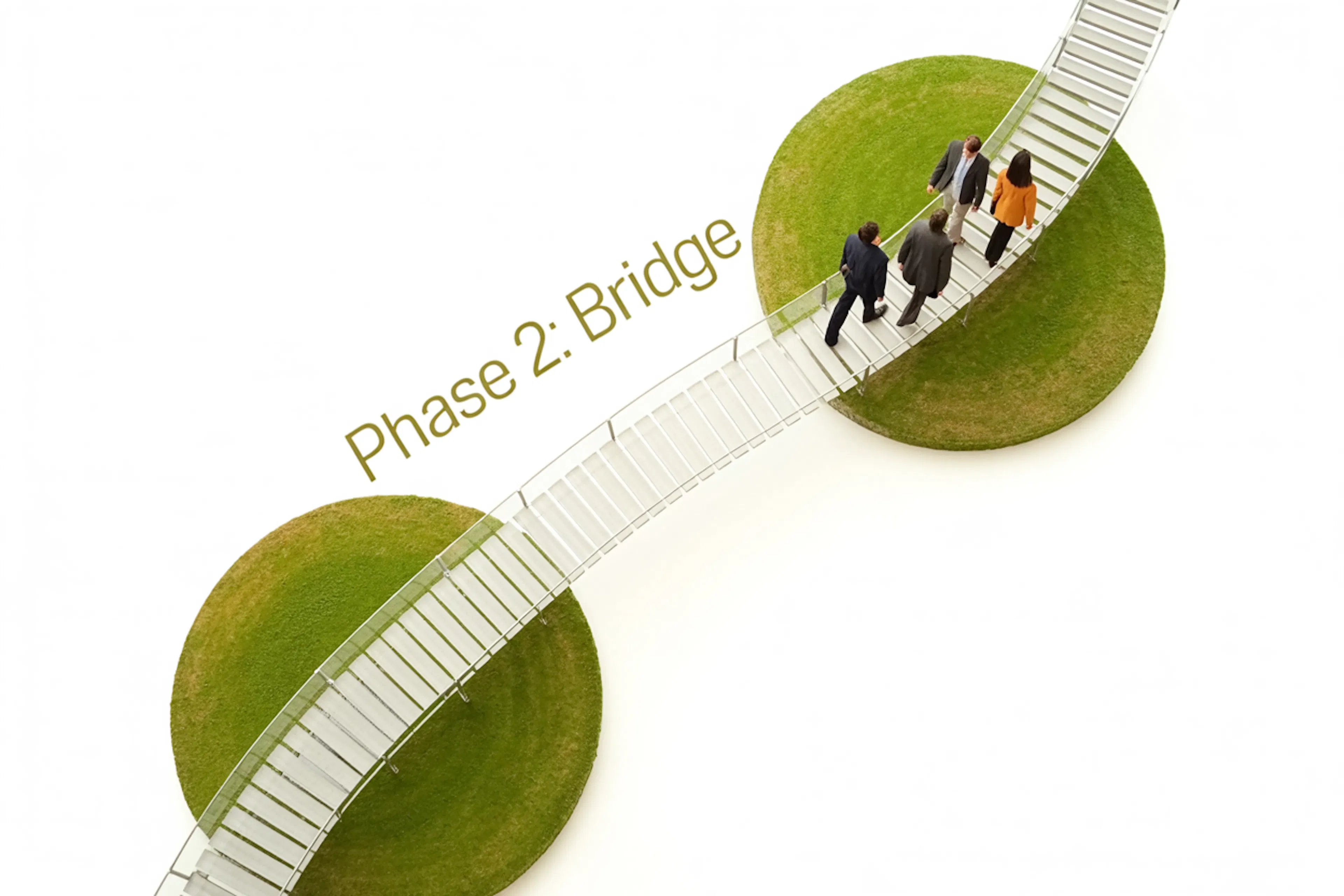
Phase 2 is when the company must bridge from community to commercialization. This is the most perilous and strategically critical phase in the life of a COSS company. After successfully igniting the project and building a vibrant community, the founders must now construct a bridge to a commercial offering. This is a delicate operation, fraught with the risk of alienating the very community that is the company's greatest asset. The landscape is littered with the ghosts of companies that got this wrong—that moved too aggressively, that appeared to "bait and switch" their users, or that sowed distrust by blurring the lines between the open source project and the commercial product.
The primary objective of Phase 2 is to validate a viable monetization path by creating a natural, value-added "on-ramp" from the free open source project to a paid commercial product, all while preserving founder optionality and community trust.
Defining the Boundary
The most important decision a founder will make in this phase is where to draw the line between the free, open source "core" and the value-added commercial offering. This decision on the monetization model will shape the company's trajectory for years to come. Perhaps the most easily overlooked part of this is embedding what the boundary is in your company DNA. The product and sales people need to be on the same page as to what boundary they're creating and how it'll evolve over time so that customer expectations can be set properly.
The most successful and community-friendly boundaries are built on a principle of addition, not subtraction. They offer more value in the commercial product rather than taking features away from the open source version.
Several proven models exist, each with its own trade-offs:
-
Open Core: This is the most common and also the most contentious model. The open source project provides the core engine, while a proprietary, commercial version adds features specifically required for enterprise deployment. These typically include functionalities like Single Sign-On (SSO), role-based access control (RBAC), advanced security auditing, and integrations with other enterprise systems. The key to a successful open core strategy is a bright, clear line. The community must feel that the open source version is a complete, powerful, and uncompromised offering in its own right, not a crippled demo. The enterprise features should be logical extensions for large organizations, not essential functions needed by the average user.
-
Managed Service / Cloud:This is often the most elegant and community-aligned model. The company offers a fully hosted, managed, and scalable version of the open source software as a cloud service. Here, the value proposition is not about proprietary features, but about convenience, operational excellence, and total cost of ownership. The company handles the complexity of deployment, scaling, backups, and security, allowing customers to focus on using the software rather than managing it. This model keeps the open source project whole and avoids any conflict with the community, as the company is contributing all its improvements back to the core project it is hosting.
-
Support, Services, and Add-ons: The classic model pioneered by Red Hat involves selling enterprise-grade support subscriptions, professional services, training, and certified add-ons. While this is a "pure" model that never compromises the open source project, it can be less scalable and yield lower margins than product-based models. However, it can be a powerful component of a hybrid strategy.
The choice of model depends heavily on the nature of the project. Infrastructure software often lends itself well to a managed service, while developer tools might be better suited for an open core model with team-based collaboration features.
Many companies implement hybrid strategies, such as offering professional services in addition to a paid enterprise product. Many companies begin with one model (e.g., professional services) and use that as a way to generate revenue and get closer to customer problems while the enterprise product is being readied.
The crucial element is transparency. The company must be crystal clear with the community about what is free, what is paid, and why.
Build a PLG Engine
We need to move past the abstract idea of "community" and treat it with the same analytical rigor that a SaaS company applies to its marketing funnel. Because that's precisely what it is—the most powerful, authentic, and efficient funnel imaginable. In the traditional SaaS playbook, Product-Led Growth (PLG) is a strategy where the product itself is the primary driver of acquisition, conversion, and expansion. The goal is to create a self-service "freemium" or trial experience that lets users see the value of the product firsthand, leading them naturally toward a paid subscription.
In a COSS business, this concept is supercharged. The open-source project is the ultimate PLG motion. It is the most effective freemium product ever conceived.
Paradigm Shift: Your Community is Your Funnel
The single most important mental shift for a COSS founder is to stop viewing the open-source project as a separate, pre-commercial activity and to see it for what it is: the top of their commercial funnel.
-
Traditional Funnel:Spends millions on ads, content, and outbound sales to generate "Marketing Qualified Leads" (MQLs). These leads are often weakly qualified, based on proxies like an e-book download. The MQL is then handed to a sales team for a high-friction, often unwelcome, sales process.
-
The COSS Flywheel: The "funnel" is an open ecosystem where potential customers self-qualify. They aren't "leads"; they are active users who have already invested significant time and resources to adopt your technology. They have moved past awareness and consideration and are deep into the evaluation and adoption phase before your commercial team ever speaks to them. This is a "Product Qualified Lead" (PQL) of the highest possible quality.
Your open-source project and the community around it act as your freemium offering. They lower the barrier to entry to zero, allowing for massive adoption and deep, hands-on user engagement. The user experiences the core value of your technology without any sales friction. This isn't just a free trial; it's an unlimited, perpetual trial that builds deep technical and organizational dependency.
From Art to Science: Instrument, Measure, and Identify Signals
If the community is your funnel, then leaving it un-instrumented is like running a marketing campaign with your eyes closed. The critical task is to systematically measure engagement to identify the signals that indicate a user or organization is ready for a commercial relationship.
This is not about spying on users. It is about understanding usage patterns in aggregate to identify where value is being created and where your commercial offering can add even more value.
A data-driven, PLG-centric approach turns your GTM motion from a speculative, high-cost sales effort into a highly efficient, value-driven process. It's the engine that powers the flywheel, ensuring the bridge from community to commercialization is a smooth, paved on-ramp, not a rickety rope bridge. Once the commercial boundary is defined, the path to purchase must be as frictionless as the initial open source experience. This is where the principles of Product-Led Growth (PLG) become essential. The massive user base of the open source project is the company's built-in funnel. The goal is to allow these users to discover and adopt the commercial offering on their own terms.
The product itself becomes the primary driver of acquisition, conversion, and expansion. Usage of the open source project provides the signals that indicate a user might be ready for the commercial product (e.g., scale of deployment, number of users, frequency of use).
Actioning the Data: The Consultative "Sales-Assist" Motion
Once you have this data, you can apply resources intelligently. You do not hand a list of IP addresses to a junior sales rep to begin cold calling. The outreach is never a sales pitch. The goal is to uncover commercial needs naturally.
Advocates and Architects, Not AEs
The early commercial hires in Phase 2 are critical and must be chosen with care. This is not the time to hire a team of traditional enterprise AEs with a rolodex and a quota. An aggressive, tone-deaf sales outreach can do irreparable damage to community trust.
Instead, the first hires should be "bridge" roles that blend technical depth with commercial acumen:
-
Developer Advocates (DevRel): Their primary role is to continue the work of Phase 1—nurturing and serving the open source community. They are the guardians of the flywheel's core. However, they also act as the eyes and ears of the company, understanding user needs, identifying potential commercial use cases, and acting as a trusted, non-sales conduit between the community and the product team.
-
Solution Architects (SAs):These are deeply technical experts who engage with larger users and organizations that are evaluating or expanding their use of the project. Their goal is not to "close a deal" but to ensure the user's success. They act as trusted advisors, helping design architectures and solve complex problems. Through this process, they naturally uncover the needs that the commercial product can address and can guide the user toward the paid offering in a consultative, value-driven way.
Objective: Clear Validation of the Commercial Offering
Phase 2 is successfully navigated when the company has its first handful of paying customers, clear validation of its commercial offering, and initial ARR traction (typically from $100k to $1M). Most importantly, all of this must be achieved while the health metrics of the open source community—contributor growth, adoption, engagement—continue to accelerate. If the community stalls or declines, the flywheel is breaking, and no amount of early revenue can fix it.
Last updated Feb 25, 2026
Built with Documentation.AI